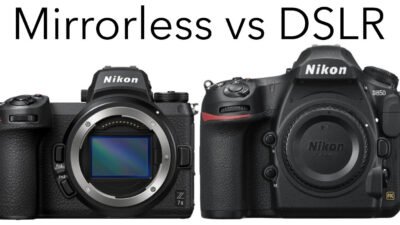
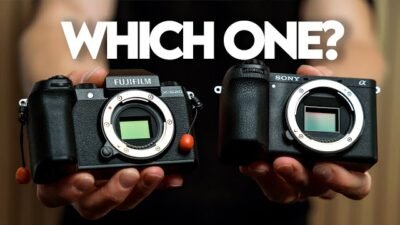
Choosing between an APS-C and a full-frame camera is one of the most common decisions photographers face when buying a camera. Both sensor types are found in capable cameras, but they differ in size, cost, lens requirements and certain aspects of image quality.
Full-frame cameras are often associated with professional photography, while APS-C cameras are popular among beginners, enthusiasts and photographers who want a more compact setup. However, the distinction is not as straightforward as it might seem. A more expensive full-frame camera is not automatically the right choice for every photographer, and an APS-C camera is not necessarily a compromise.
The differences become particularly important when photographing in low light, creating portraits with a blurred background, shooting wildlife or building a camera system on a limited budget.
In this guide, we’ll explain how APS-C and full-frame sensors differ, what those differences mean in everyday photography, and what to consider before choosing either format.
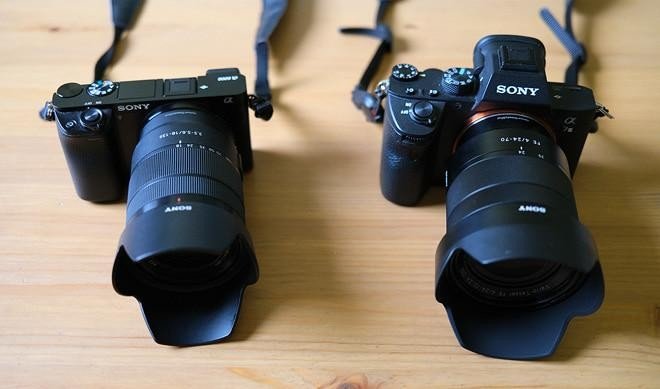
APS-C and full-frame cameras can look similar, but their sensor sizes affect several aspects of photography.
APS-C vs Full-Frame: Quick Comparison
| Feature | APS-C | Full-frame |
|---|---|---|
| Sensor size | Approximately 22–24mm wide | 36mm wide |
| Typical resolution | 20–33MP | 24–60MP or more |
| Low-light performance | Very capable | Generally better at equivalent technology and output |
| Background blur | Generally less at equivalent framing and aperture | Easier to achieve |
| Crop factor | Usually 1.5× or 1.6× | 1× |
| Camera and lens cost | Generally lower | Generally higher |
| Camera body size | Often smaller | Varies by model |
| Lens size | Often smaller for equivalent framing | Can be larger, depending on lens |
| Wildlife photography | Useful extra reach with suitable lenses | Often requires longer lenses for equivalent framing |
| Portrait photography | Excellent | Greater potential for shallow depth of field |
| Landscape photography | Excellent | More flexibility for certain wide-angle and high-resolution needs |
| Beginner suitability | Excellent | Also suitable, but often more expensive |
These are general comparisons. Actual performance depends on the particular camera, sensor generation, lens, shooting conditions and output requirements.
1. What Is an APS-C Camera?
An APS-C camera is a digital camera that uses an APS-C-sized image sensor. The name comes from the Advanced Photo System film format, although modern APS-C digital sensors are not identical to the original film dimensions.
Most APS-C sensors measure approximately 23.5 × 15.6mm, although dimensions vary between manufacturers. Canon’s APS-C sensors, for example, are typically slightly smaller.
APS-C cameras are available in entry-level, enthusiast and professional-oriented models. They are not restricted to beginners.
Examples include the Sony A6700, Fujifilm X-T5 and Canon EOS R7.

One of the main attractions of APS-C is its combination of image quality, portability and affordability. The smaller sensor can allow manufacturers to produce relatively compact camera bodies and lenses while still offering substantial resolution and advanced photographic features.
For many photographers, an APS-C camera provides more than enough image quality for social media, websites, prints, events, travel and even professional assignments.
2. What Is a Full-Frame Camera?
A full-frame camera uses a sensor measuring approximately 36 × 24mm, corresponding to the dimensions of a traditional 35mm film frame.
This sensor is considerably larger than a typical APS-C sensor. When both sensors have similar technology and are used at the same exposure and framing conditions, the larger sensor can collect more total light.
Full-frame cameras are available in a wide range of models, from relatively compact mirrorless bodies to large professional cameras.
Examples include the Sony A7 IV, Canon EOS R6 Mark II and Nikon Z6 III.

The larger sensor can provide advantages in certain shooting conditions, particularly when photographers want shallow depth of field, greater light-gathering capacity or high-resolution output.
However, these advantages come with potential trade-offs, including higher equipment costs and larger lenses for some equivalent shooting setups.
3. APS-C vs Full-Frame: Understanding Sensor Size
The most fundamental difference between these camera types is the size of their image sensors.
A typical full-frame sensor measures 36 × 24mm, while a common APS-C sensor measures approximately 23.5 × 15.6mm.

Full-frame sensors have a larger surface area than APS-C sensors.
A typical APS-C sensor has roughly 40–45% of the surface area of a full-frame sensor, depending on the manufacturer’s sensor dimensions.
This difference affects several aspects of photography, but it is important to understand what it does and does not mean.
A larger sensor does not automatically produce a sharper photograph. Sharpness also depends on lens quality, focus accuracy, shutter speed, resolution and other factors.
Likewise, a smaller sensor does not automatically mean poor image quality. Modern APS-C cameras can capture highly detailed photographs suitable for many professional applications.
The most useful way to think about sensor size is as one factor in a camera system, rather than a direct measure of overall camera quality.
4. Image Quality: Is Full-Frame Really Better?
Image quality is one of the biggest reasons people consider upgrading from APS-C to full-frame. However, the actual difference depends on how the photographs are taken and viewed.
Both sensor formats can produce excellent photographs, but full-frame has some advantages under certain conditions.
Resolution and detail
Resolution determines how many pixels a camera uses to record an image. It is usually expressed in megapixels (MP).
Full-frame cameras are available with a wide range of resolutions, including 24MP, 33MP, 45MP and higher. APS-C cameras commonly offer resolutions between approximately 20MP and 33MP.
However, sensor size alone does not determine resolution. A 26MP APS-C camera can capture more detail than a lower-resolution full-frame camera, particularly when the latter has a less suitable lens or is not focused accurately.
For everyday photography, a modern 24MP or 26MP camera is sufficient for most online publishing, social media and many print applications.
Higher-resolution full-frame cameras can be particularly useful when making large prints or cropping photographs heavily, although high-resolution APS-C cameras can also provide substantial detail.
Dynamic range
Dynamic range describes how much detail a camera can record between the darkest and brightest parts of a scene.
A camera with good dynamic range can retain more information in shadows and highlights, making it easier to recover detail during editing.
Full-frame sensors often have an advantage in total light collection when comparing cameras with similar sensor technology and resolution. However, actual dynamic range varies considerably between individual models.
Some APS-C cameras offer excellent dynamic range and are capable of producing photographs with substantial editing flexibility.
Colour reproduction
Both sensor formats can produce natural and attractive colours.
Colour differences between cameras are influenced by the sensor’s colour-filter array, image processor, white balance, picture profiles and editing software.
Full-frame does not inherently mean better colour reproduction. A photographer may prefer the JPEG colour rendering of an APS-C camera over that of a full-frame model.
The important distinction: full-frame can provide certain image-quality advantages, but APS-C is more than capable of producing professional-quality photographs.
5. Low-Light Photography: Which Sensor Performs Better?
Low-light performance is one area where full-frame cameras often have a measurable advantage.
Because a full-frame sensor has a larger surface area, it can collect more total light than a smaller sensor when both use comparable technology and are photographed under equivalent conditions.
This can help produce cleaner images at higher ISO settings, particularly when the photographs are compared at the same output size.

However, several factors determine how well a camera performs in low light.
- Sensor technology and generation
- Lens maximum aperture
- Shutter speed
- ISO sensitivity
- Image processing
- Noise reduction
- Subject movement
Consider two photographers taking a photograph indoors. One uses an APS-C camera with an f/1.4 lens, while the other uses a full-frame camera with an f/4 lens.
The APS-C photographer may be able to capture a brighter image with less motion blur because the wider aperture allows considerably more light to reach the sensor.
This illustrates why comparing sensor sizes without considering lenses can produce misleading conclusions.
Full-frame generally offers greater flexibility in low-light photography, but an appropriate lens can make an enormous difference to either system.
Which should you choose?
If you regularly photograph concerts, indoor events, nighttime street scenes or other challenging lighting conditions, a full-frame camera may be worth considering. However, a fast APS-C lens can be a more affordable solution for many photographers.
6. Background Blur and Depth of Field
Background blur is another major difference between APS-C and full-frame photography.
Photographers often use a blurred background to separate their subjects from distracting elements. This technique is especially common in portraits, wedding photography, product photography and some types of wildlife photography.

Shallow depth of field

Greater depth of field
When using equivalent framing and the same f-number, a full-frame camera generally produces shallower depth of field than an APS-C camera.
For example, a photographer using a 50mm f/1.8 lens on a full-frame camera can achieve a shallower depth of field than someone using the same 50mm lens on an APS-C camera, assuming the same framing and shooting position are achieved.
This makes full-frame particularly attractive for photographers who frequently create portraits with strongly blurred backgrounds.
However, APS-C cameras can also produce attractive background blur, particularly when paired with fast prime lenses.
A 56mm f/1.2 lens on an APS-C camera, for example, can produce substantial background separation for portraits.
It is also worth remembering that background blur depends on subject distance, background distance, focal length and aperture. Sensor size is only one part of the equation.
Full-frame has an advantage for achieving shallow depth of field, but APS-C is perfectly capable of producing beautiful portraits.
7. Crop Factor: Why Focal Length Matters
One of the most misunderstood aspects of APS-C cameras is crop factor.
Crop factor describes how a smaller sensor captures a narrower field of view than a full-frame sensor when using the same lens from the same position.
Most APS-C cameras from Sony, Fujifilm and Nikon have a crop factor of approximately 1.5×. Canon APS-C cameras generally have a crop factor of approximately 1.6×.
For example:
| Lens focal length | 1.5× APS-C equivalent | Full-frame field of view |
|---|---|---|
| 16mm | 24mm | 16mm |
| 23mm | 34.5mm | 23mm |
| 35mm | 52.5mm | 35mm |
| 50mm | 75mm | 50mm |
| 85mm | 127.5mm | 85mm |
| 200mm | 300mm | 200mm |
These equivalent focal lengths describe field of view, not a physical change in the lens’s focal length.

This is particularly useful for wildlife and sports photography. A 200mm lens on a typical 1.5× APS-C camera provides approximately the same field of view as a 300mm lens on full-frame.
However, crop factor does not actually magnify the subject or increase the lens’s optical focal length. It simply captures a smaller portion of the image projected by the lens.
For photographers who regularly photograph distant subjects, this narrower field of view can be useful, especially when paired with an appropriate telephoto lens.
On the other hand, photographers who enjoy wide-angle photography may find it easier to achieve very wide fields of view with full-frame equipment.
8. Camera and Lens Costs
The price difference between APS-C and full-frame systems can be substantial, especially when building a complete photography kit.
APS-C cameras are generally available at lower entry prices. Their lenses can also be smaller and less expensive, depending on the focal length and aperture.
Full-frame cameras tend to cost more, particularly in the professional and high-resolution categories. Some full-frame lenses can also be considerably more expensive than their APS-C equivalents.
However, the price difference is not universal. Premium APS-C cameras and lenses can cost as much as some entry-level full-frame options.
| Expense | APS-C | Full-frame |
|---|---|---|
| Entry-level body | Generally less expensive | Generally more expensive |
| Professional body | Can be expensive | Often very expensive |
| Standard zoom lens | Often compact and affordable | Wide price range |
| Fast portrait lenses | Often relatively affordable | Can be expensive |
| Telephoto lenses | Often smaller for similar framing | Can be larger and more expensive |
| Complete system | Often lower cost | Often higher cost |
For someone starting photography on a limited budget, APS-C can offer an important financial advantage.
Rather than spending most of your budget on a full-frame camera body, you could purchase an APS-C camera and invest the remaining money in a better lens, lighting equipment or other accessories.
That investment may make a greater practical difference to your photographs than upgrading the sensor alone.
9. Camera Size and Portability
APS-C cameras are often associated with compact photography systems. Their smaller sensors can allow manufacturers to design smaller camera bodies and lenses, although the difference varies significantly between models.

For travel photographers, hikers and people who carry their cameras every day, a smaller system can be particularly appealing.
However, not every APS-C camera is small, and not every full-frame camera is large. Some full-frame mirrorless bodies are remarkably compact.
The lens often makes a greater difference to the weight of the complete setup than the camera body itself.
For example, an APS-C camera with a large telephoto lens may be heavier than a full-frame camera paired with a small prime lens.
When comparing systems, consider the combined weight of the camera, lens, batteries and accessories rather than looking at the camera body alone.
APS-C generally has a portability advantage, particularly when paired with compact lenses.
10. APS-C vs Full-Frame for Portrait Photography
Both sensor formats are suitable for portrait photography, but they offer somewhat different advantages.
Full-frame cameras make it easier to achieve shallow depth of field and pronounced background blur, especially when paired with fast lenses.
They also offer a wide range of portrait lenses, including 85mm and 135mm options that are popular among portrait photographers.
APS-C cameras can also produce excellent portraits. Their smaller sensor makes it easier to achieve greater depth of field at equivalent framing and aperture, which can be useful when photographing groups or when you want more of the subject in focus.
The cost of portrait lenses is another consideration. An APS-C camera paired with a fast portrait lens can provide attractive results without the expense of a complete full-frame system.
| Portrait requirement | Suitable option |
|---|---|
| Strong background blur | Full-frame |
| Affordable portrait setup | APS-C |
| Professional studio portraits | Both |
| Group portraits | Both |
| Lightweight portrait setup | Often APS-C |
| High-resolution commercial portraits | Depends on the camera |
Which should you choose?
If you frequently create portraits with very shallow depth of field, full-frame offers more flexibility. If you are learning portrait photography or working within a budget, APS-C is an excellent starting point.
11. APS-C vs Full-Frame for Wildlife Photography
Wildlife photography often involves photographing animals from considerable distances. This makes focal length and autofocus particularly important.
APS-C cameras can be attractive for wildlife photographers because their crop factor provides a narrower field of view with the same lens.
For example, a 400mm lens on a 1.5× APS-C camera provides a field of view equivalent to 600mm on full-frame.

This can be useful when photographing birds, distant mammals and other wildlife.
Full-frame cameras, however, can offer advantages in low-light conditions, particularly when photographing animals at dawn or dusk. Many high-end full-frame models also provide advanced autofocus and high-resolution sensors.
It is important not to confuse crop factor with additional optical magnification. If both cameras have similar pixel densities, cropping a full-frame image to the same field of view can produce comparable results.
The lens, sensor resolution, autofocus and shooting conditions all matter.
For wildlife photography, APS-C can offer practical reach and lower system costs, while full-frame may offer advantages in low light and certain high-resolution applications.
12. APS-C vs Full-Frame for Landscape Photography
Landscape photography is another area in which both sensor formats perform well.
Full-frame cameras can be particularly useful for photographers who need high resolution, wide-angle lenses and flexibility in challenging lighting conditions.
Their larger sensors can also provide advantages in dynamic range and noise performance, depending on the models being compared.
However, APS-C cameras are entirely capable of producing detailed landscape photographs, including images suitable for large prints.
A photographer using a good APS-C camera and a quality wide-angle lens can produce excellent landscape images.
The choice may come down to the desired field of view, resolution, equipment budget and whether portability is important.
| Landscape requirement | Suitable option |
|---|---|
| Wide-angle photography | Both |
| High-resolution large prints | Depends on the model |
| Lightweight hiking setup | Often APS-C |
| Extensive shadow recovery | Depends on sensor generation |
| Affordable landscape setup | APS-C |
| Professional landscape photography | Both |
For many landscape photographers, lens quality, tripod use, composition and lighting are more important than the difference between these sensor formats.
13. APS-C vs Full-Frame for Video
Both APS-C and full-frame cameras can produce excellent video, including high-resolution 4K footage.
However, the video capabilities of individual cameras can vary considerably, even within the same sensor category.
Full-frame cameras can offer attractive depth-of-field effects and good low-light performance. These qualities can be useful for interviews, filmmaking and cinematic video.
APS-C cameras can provide a more affordable route into video production. Some models also offer advanced recording formats, high frame rates and professional video features.
For example, the Fujifilm X-S20 offers internal 6.2K recording, while the Sony A6700 supports 4K recording at up to 120 frames per second. These examples demonstrate why the individual camera’s specifications matter more than sensor size alone.
When choosing a camera for video, pay attention to:
- Maximum recording resolution
- Available frame rates
- Internal 10-bit recording
- Video codecs
- Autofocus performance
- Recording limits
- Overheating behaviour
- Image stabilization
- Audio connections
A full-frame camera is not automatically better for filmmaking. An APS-C camera with the required recording features may be a more practical purchase for many content creators.
14. Which Sensor Size Is Better for Beginners?
For most beginners, APS-C offers a practical starting point.
It provides excellent image quality, access to interchangeable lenses and a wide range of cameras at different prices.
The lower initial cost can also leave room in the budget for equipment that helps develop photography skills, such as a fast prime lens, a tripod or external lighting.

Full-frame cameras are also suitable for beginners. There is no technical requirement to master APS-C before moving to full-frame.
However, the additional expense may not provide a noticeable benefit to someone who primarily photographs family events, holidays, everyday subjects or social media content.
For a beginner, learning exposure, composition, lighting and focusing will usually make a more immediate difference than choosing a larger sensor.
15. Can You Upgrade from APS-C to Full-Frame Later?
Yes, but upgrading may involve more than replacing the camera body.
Some manufacturers offer camera systems with compatible mounts across APS-C and full-frame models. Sony’s E-mount is one example, allowing many APS-C E-mount lenses to be mounted on compatible full-frame cameras.
However, APS-C lenses generally cover a smaller image circle. When used on compatible full-frame cameras, they may require crop mode, reducing the available image resolution.
Other camera systems have different mount and compatibility arrangements. Fujifilm’s X-mount, for example, is designed for its APS-C cameras rather than its medium-format GFX cameras.
Before choosing a camera system, consider whether you may want to move to another sensor format later.
If you already own several lenses, changing systems can become an expensive process. Buying into a system with your long-term needs in mind can help you avoid unnecessary spending.
16. Common Myths About APS-C and Full-Frame Cameras
There are several misconceptions that can make choosing between these sensor formats more confusing than it needs to be.
Myth 1: Full-frame cameras always produce sharper photographs.
Fact: Sharpness depends on resolution, lens quality, focusing, shutter speed and technique. A high-resolution APS-C camera can produce extremely detailed images.
Myth 2: APS-C cameras are only for beginners.
Fact: Many experienced and professional photographers use APS-C cameras for wildlife, travel, sports, events and other demanding assignments.
Myth 3: Full-frame is always better in low light.
Fact: Full-frame often has a light-gathering advantage, but lens aperture, sensor technology, exposure and image processing also have a significant effect.
Myth 4: APS-C cameras make every lens more powerful.
Fact: Crop factor changes the field of view, not the actual focal length or optical magnification of the lens.
Myth 5: Professional photographers must use full-frame.
Fact: Professional suitability depends on the assignment and the camera’s capabilities. Sensor size alone does not determine whether a camera is suitable for professional work.
Myth 6: Full-frame cameras are always larger and heavier.
Fact: Some full-frame mirrorless cameras are compact, while certain APS-C bodies and their lenses can be relatively large.
APS-C vs Full-Frame: Which Should You Buy in 2026?
The choice ultimately depends on your photography requirements, budget and preferred equipment.

Choose APS-C if you:
- Are buying your first interchangeable-lens camera.
- Want to keep your equipment costs manageable.
- Prefer a relatively lightweight camera system.
- Photograph wildlife or distant subjects.
- Want excellent image quality without paying for features you may not need.
- Primarily publish photographs online.

Choose full-frame if you:
- Frequently photograph in challenging lighting.
- Want greater flexibility for shallow depth of field.
- Need high-resolution output from a suitable model.
- Work with professional portrait, event or commercial photography.
- Want a particular full-frame lens or camera system.
- Have a budget that comfortably accommodates the complete system.
Our Recommendation
For most beginners, enthusiasts and photographers who want to build a capable camera system without excessive spending, APS-C is a very sensible choice.
Its combination of image quality, portability and relatively affordable equipment makes it suitable for a wide range of photographic applications. There are also plenty of advanced APS-C cameras capable of meeting demanding professional requirements.
Full-frame is worth considering when you have specific needs that benefit from its larger sensor, such as particularly shallow depth of field, demanding low-light photography or high-resolution output.
However, the decision should not be based on the assumption that a larger sensor automatically produces better photographs.
Before purchasing either format, compare the actual cameras and lenses available within your budget. Consider what you photograph, how much equipment you are willing to carry and whether the system offers the features you will use regularly.
For many photographers, an APS-C camera with a suitable lens will provide everything they need. For others, the advantages of full-frame will justify the additional investment.
The right sensor size is the one that supports your photography without making the equipment itself an unnecessary limitation.
Frequently Asked Questions
Is APS-C good enough for professional photography?
Yes. Modern APS-C cameras can produce professional-quality images and are used for a wide range of assignments, including portraits, wildlife, travel, sports and commercial photography. The suitability of a camera depends on the specific job and its technical requirements.
Is full-frame worth the extra money?
It can be, particularly if you regularly work in low light, require shallow depth of field or need the resolution and features of a particular full-frame model. However, many photographers will find that a less expensive APS-C camera meets their needs.
Does APS-C have worse image quality than full-frame?
Not necessarily. Full-frame cameras often have advantages in total light collection, but actual image quality depends on sensor technology, lens quality, exposure and processing. Modern APS-C cameras can produce excellent photographs.
Is full-frame better for night photography?
Full-frame cameras often have an advantage in low-light performance when comparing similar sensor generations and equivalent output. However, a fast lens and appropriate exposure can make a substantial difference, even on APS-C cameras.
Which is better for portraits, APS-C or full-frame?
Full-frame generally makes it easier to achieve very shallow depth of field and strong background blur. APS-C is also excellent for portraits, particularly when paired with a fast portrait lens.
Is APS-C better for wildlife photography?
APS-C can be advantageous because its crop factor provides a narrower field of view with the same lens. This can be useful for distant subjects. Full-frame, however, can offer advantages in low light and may provide more flexibility for cropping with high-resolution models.
Does crop factor affect image quality?
Crop factor itself does not reduce the optical quality of a lens. However, a smaller sensor captures a smaller portion of the image projected by that lens. Image quality depends on the sensor, lens, exposure and other factors.
Can I use APS-C lenses on a full-frame camera?
Some camera systems allow this. For example, compatible Sony APS-C E-mount lenses can be used on Sony full-frame E-mount bodies, generally with crop mode or with potential vignetting. Compatibility varies, so check the specific lens and camera before purchasing.
Is a 24MP APS-C camera better than a 24MP full-frame camera?
Neither is automatically better. Both offer the same nominal number of pixels, but sensor size can influence noise performance and depth of field. The specific sensor, lens and shooting conditions determine the final result.
Should I buy APS-C or full-frame in 2026?
If you are starting out or working with a limited budget, APS-C is an excellent starting point. If you have specific requirements that benefit from full-frame and can afford the complete system, it may be the more appropriate choice.
Zeedaxz: The Bottom Line
APS-C and full-frame cameras both offer excellent photographic capabilities. APS-C provides an accessible combination of performance, portability and cost, while full-frame offers additional flexibility in certain demanding situations.
Before spending more on a larger sensor, consider whether the difference will actually improve the photographs you want to take.