If you are shopping for your first serious camera in 2026, one of the first decisions you will probably encounter is mirrorless vs DSLR.
At first glance, the difference may seem simple. A DSLR has a mirror, while a mirrorless camera does not. But that small mechanical difference affects how you see your subject, how autofocus works, how the camera handles video, how large the system can be, and even which lenses you should consider.
The good news is that both types of cameras can produce excellent photographs. The more important question is which system makes more sense for the way you intend to shoot.
For most people buying a new interchangeable-lens camera in 2026, mirrorless is the better starting point. However, that does not mean DSLRs are suddenly bad cameras. A DSLR can still be a very sensible choice, particularly if you are buying used equipment, already own DSLR lenses, or prefer an optical viewfinder and long battery life.
Let’s look at the differences without getting buried in technical jargon.
Mirrorless vs DSLR at a Glance
| Feature | Mirrorless | DSLR |
|---|---|---|
| Viewfinder | Electronic (EVF) | Optical (OVF) |
| Internal mirror | No | Yes |
| Typical body size | Usually smaller | Usually larger |
| Autofocus | Often excellent, especially on newer models | Excellent on many established models |
| Video | Generally better suited | More limited on many older models |
| Battery life | Usually shorter | Usually longer |
| Image stabilization | Common on many models | Less common in the body |
| Silent shooting | Common on many models | More limited |
| Lens choices | Growing rapidly | Large used and existing market |
| New-system development | Very active | Much more limited |
| Best for new buyers | Usually mirrorless | Mainly specific situations or bargains |
The important thing to remember is that these are general tendencies, not rules for every camera. A particular DSLR can outperform a particular mirrorless camera in one area, just as an entry-level mirrorless camera can be less capable than a professional DSLR.
What Is the Difference Between a DSLR and a Mirrorless Camera?
The biggest difference is what happens to the light entering the lens.
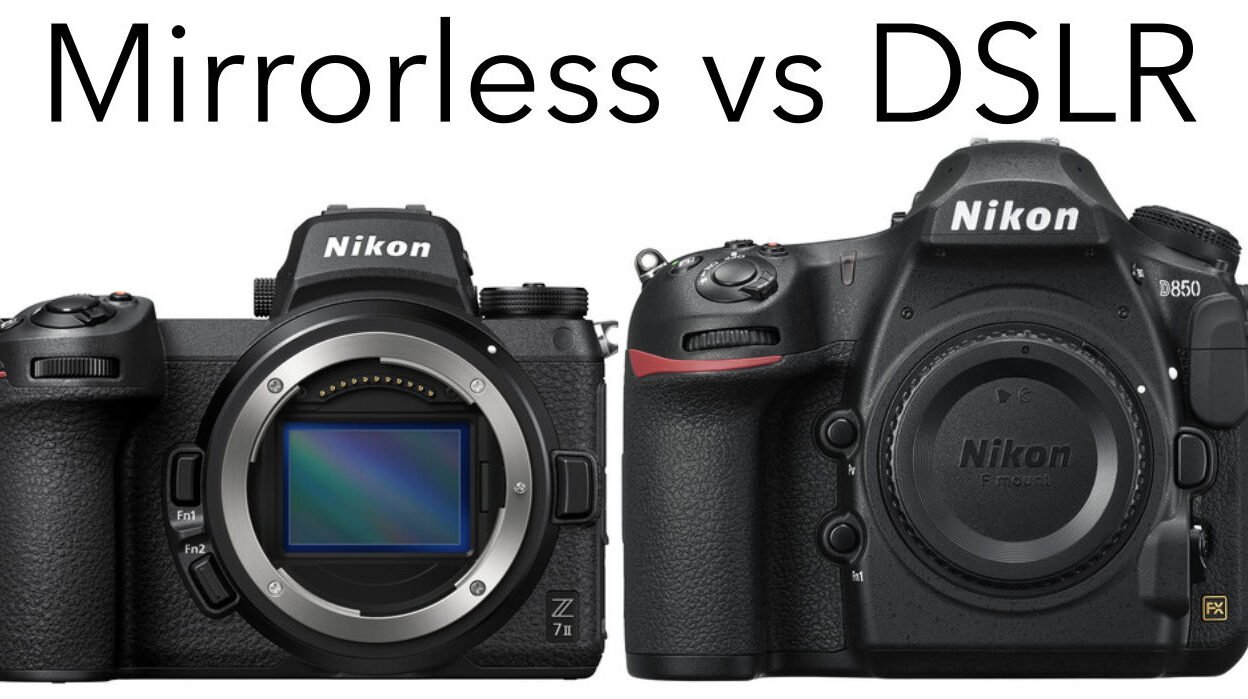
A DSLR, or Digital Single-Lens Reflex camera, uses a mirror inside the camera body. Light coming through the lens is reflected by this mirror toward an optical viewfinder. When you take a photograph, the mirror moves out of the way so that light can reach the image sensor.
A mirrorless camera removes this mirror mechanism. Light from the lens reaches the image sensor directly, and the camera uses that sensor to provide the image displayed on the rear screen or electronic viewfinder.
That sounds like a small engineering change, but it has important consequences.
Mirrorless cameras can use the imaging sensor for functions such as autofocus, exposure preview, and subject recognition. Modern mirrorless cameras have consequently become extremely sophisticated, with some current models offering advanced subject-recognition autofocus and very fast continuous shooting.
1. Viewfinder: Optical vs Electronic
This is arguably the biggest difference you will notice when actually using the two systems.
DSLR: Optical Viewfinder
A DSLR’s optical viewfinder allows you to look through the lens using the camera’s mirror and optical system.
You are essentially seeing the scene directly rather than looking at a small electronic display.
Many photographers still love this experience because it feels immediate and natural.
An optical viewfinder also does not require the camera to continuously power an electronic display, which contributes to the generally strong battery life of many DSLRs.
Mirrorless: Electronic Viewfinder
A mirrorless camera’s electronic viewfinder, or EVF, is a small display that shows the image captured by the camera’s sensor.
This provides an important advantage:
You can see a preview of what the photograph is likely to look like before taking it.
Depending on the camera, you can see the effects of exposure, white balance and other settings in the viewfinder. Modern EVFs have also become extremely sophisticated, although their quality and responsiveness vary considerably between models.
For someone learning photography, this can be particularly useful.
Instead of taking a photograph and then checking the screen to discover that it is too dark, you can often see the effect of your exposure settings before pressing the shutter.
Which is better?
Choose an optical viewfinder if:
- You prefer seeing the scene naturally.
- You value the traditional DSLR shooting experience.
- You want excellent battery efficiency.
- You already enjoy using an optical finder.
Choose an electronic viewfinder if:
- You want exposure previews.
- You shoot both photographs and video.
- You want focus peaking and other electronic overlays.
- You want more information displayed while composing.
For most new photographers, I would give the advantage to mirrorless here.
2. Autofocus
Autofocus is one area where the old reputation of mirrorless cameras no longer tells the whole story.
Early mirrorless cameras were often criticized for autofocus performance, particularly when tracking moving subjects. Modern mirrorless cameras have changed that considerably.
Many current mirrorless systems use sophisticated hybrid autofocus systems that combine phase-detection and other focusing methods. Newer cameras can also recognize and track subjects such as people, animals and vehicles.
This can be particularly useful for:
- Sports
- Wildlife
- Children
- Weddings
- Events
- Birds
- Video production
DSLR autofocus systems can still be extremely capable, particularly in dedicated optical-viewfinder shooting. Professional DSLRs built for sports and wildlife were developed over many years and earned strong reputations for tracking moving subjects.
However, the development momentum has clearly moved toward mirrorless.
Advantage in 2026: Mirrorless
3. Image Quality
This is where many beginners have a misconception.
A mirrorless camera does not automatically produce better image quality simply because it is mirrorless.
Image quality depends much more on factors such as:
- Sensor size
- Sensor design
- Lens quality
- Exposure
- Image processing
- Lighting
- Photographer technique
A full-frame DSLR and a full-frame mirrorless camera can produce remarkably similar image quality because the fundamental image-making process is based on the sensor and lens rather than the presence or absence of a mirror.
In other words, don’t buy a camera simply because you see the word “mirrorless” and assume that your photographs will automatically be better.
Advantage: Tie
4. Size and Weight
Mirrorless cameras have traditionally had an advantage here because removing the mirror and optical viewfinder mechanism allows manufacturers to design a more compact body.
However, there is an important catch.
A smaller camera body does not necessarily mean a small camera system.
Large full-frame lenses can still be substantial, and professional mirrorless bodies have also become larger to provide better ergonomics, controls, batteries and heat management.
So if portability matters to you, don’t compare camera bodies alone.
Compare:
Camera body + lens + battery + accessories
That is what you will actually carry.
Advantage: Usually mirrorless
5. Video
If video is important to you, mirrorless is generally the easier choice.
The architecture of a mirrorless camera is naturally suited to video because the imaging sensor is already being used to display the live image.
Modern mirrorless cameras can offer features such as advanced autofocus tracking, electronic viewfinders, stabilization, high-resolution recording and other video-focused functions.
DSLRs can certainly record excellent video. Some models remain perfectly capable for filmmaking and content creation.
However, if you are buying a new camera primarily for YouTube, social media, filmmaking or hybrid photo/video work, mirrorless makes considerably more sense in 2026.
Advantage: Mirrorless
6. Battery Life
This is one area where DSLRs still have a genuine advantage.
Because a DSLR’s optical viewfinder does not require a continuously powered electronic display, many DSLRs can operate for a large number of photographs on a single battery.
Mirrorless cameras need to power their sensor and electronic display during normal shooting, which generally increases power consumption.
That does not mean mirrorless battery life is poor. Modern cameras have improved substantially, and many can also be charged through USB-C.
But if your priority is getting as many photographs as possible from one battery, a DSLR can still be attractive.
Advantage: DSLR
7. Lens Selection
This is where you need to think beyond the camera body.
DSLR systems have been around for decades, so there is a huge ecosystem of lenses, particularly on the used market.
Mirrorless systems are newer, but their native lens selections have expanded rapidly.
There is also another possibility: adapters.
Depending on the camera system, some older DSLR lenses can be used on newer mirrorless bodies with an adapter. However, compatibility and autofocus performance can vary, so you should always check the specific combination before buying.
If you already own several DSLR lenses, switching to mirrorless does not necessarily mean you need to throw everything away.
Advantage: Depends on your situation
8. Image Stabilization
Many modern mirrorless cameras offer in-body image stabilization (IBIS).
IBIS works by moving the camera’s sensor to compensate for small movements from the photographer.
This can be especially useful when shooting:
- Handheld in low light
- Landscapes
- Street photography
- Indoor scenes
- Video
- Slow shutter speeds
Some DSLRs rely primarily on stabilization built into compatible lenses, although the exact situation varies between brands and models.
Modern mirrorless systems have pushed stabilization much further, with some high-end cameras offering very substantial stabilization performance.
Advantage: Mirrorless
9. Silent Shooting
Another advantage of mirrorless cameras is the availability of electronic shutter modes on many models.
This can allow extremely quiet or completely silent shooting.
That can be useful for:
- Weddings
- Wildlife
- Theater
- Museums
- Street photography
- Events
It is worth noting that electronic shutters are not perfect. Under some lighting conditions or with very fast movement, they can introduce distortion or other artifacts.
So “silent” does not automatically mean “better.”
Still, the option is extremely useful.
Advantage: Mirrorless
10. Are DSLRs Still Worth Buying in 2026?
Yes.
This is where I think a lot of camera-buying advice becomes unnecessarily extreme.
The fact that mirrorless cameras dominate new camera development does not make existing DSLRs useless.
A good DSLR can still take outstanding photographs.
In fact, buying an older DSLR can be a smart decision if you are working with a limited budget and can find a good used camera and lens combination.
A used DSLR may give you:
- Excellent image quality
- A large selection of inexpensive used lenses
- Long battery life
- A comfortable optical viewfinder
- Proven reliability
- A relatively low entry price
There is also a major consideration for existing DSLR owners:
If you already own several good DSLR lenses, switching systems can become expensive.
In that situation, keeping your current DSLR may make more financial sense than upgrading simply because mirrorless is newer.
So, Which Should You Buy in 2026?
For someone buying their first interchangeable-lens camera today, I would generally recommend mirrorless.
Not because DSLRs are incapable, but because mirrorless systems are where most of the industry’s current development is happening.
The advantages are particularly compelling if you want:
- Modern autofocus
- Strong video capabilities
- A compact system
- Electronic exposure preview
- Subject recognition
- In-body stabilization
- Silent shooting options
- A system you can continue upgrading over many years
Current camera development strongly reflects this shift. By 2026, mirrorless cameras occupy the mainstream of interchangeable-lens camera development, with current models spanning beginner, enthusiast and professional markets.
But there are still situations where I’d recommend a DSLR.
Choose Mirrorless If…
You’re buying your first serious camera.
You have the opportunity to start with a modern system rather than investing in an older platform.
You want to shoot video.
Mirrorless cameras are generally much better suited to hybrid photography and video.
You photograph moving subjects.
Modern subject-recognition and tracking systems can make photographing people, animals and sports considerably easier.
You travel frequently.
A compact body and lens combination can make carrying your equipment more convenient.
You want the latest camera technology.
Most new development is happening in mirrorless systems.
Choose a DSLR If…
You already own DSLR equipment.
Your existing lenses may be more valuable to you than the benefits of switching systems.
You want the best possible value on the used market.
Older DSLRs can offer impressive image quality for relatively little money.
You love optical viewfinders.
There is nothing wrong with preferring the traditional shooting experience.
Battery life is extremely important to you.
A DSLR can still have an advantage here.
You find a particularly good used camera deal.
A well-maintained DSLR with a good lens can still be an excellent photographic tool.
What About Image Quality?
This deserves its own answer because it is one of the most common questions.
Mirrorless does not automatically mean better image quality.
If you compare two cameras with similar sensor sizes, similar technology and comparable lenses, the difference in the final photograph may be far smaller than a beginner expects.
A photographer using a good DSLR with an appropriate lens can produce better photographs than someone using an expensive mirrorless camera with poor technique.
The camera is a tool.
The photographer, lens, light and subject all matter.
What About Beginners?
For most beginners buying new equipment in 2026, I’d choose mirrorless.
One of its biggest advantages for a beginner is the ability to see the effects of many settings before taking the photograph.
If you adjust exposure compensation or other settings, the electronic viewfinder can give you a useful preview of what is happening.
That makes the camera less mysterious when you’re learning.
However, don’t assume you need an expensive professional camera.
A relatively affordable mirrorless body with a good kit lens can be more than enough for someone learning photography.
In fact, spending less on the camera body and putting some of the budget toward a useful lens may be the smarter decision.
The Real Question: Which Camera System Should You Invest In?
This is perhaps more important than the DSLR-versus-mirrorless debate itself.
When buying an interchangeable-lens camera, you are not just buying a camera.
You are buying into a system.
That system can include:
- Camera bodies
- Lenses
- Batteries
- Flashes
- Memory cards
- Adapters
- Tripods
- Accessories
A camera body might last a few years, but your lenses can potentially stay with you much longer.
So before buying, look at the lenses available for the system you are considering.
Ask yourself:
Can this system give me the lenses and features I will That question may be more valuable than asking which camera has the highest megapixel count.
Mirrorless vs DSLR: Final Verdict
If you’re starting from scratch in 2026, mirrorless is the choice I would make for most people.
It offers the combination of modern autofocus, electronic viewfinders, strong video capabilities, compact designs, stabilization and continued development that makes it the more future-oriented option.
But don’t write off DSLRs.
If you already own one, there’s no reason to replace it simply because mirrorless cameras are newer. And if you find an affordable used DSLR with good lenses, it can still be an excellent way to get into serious photography.
The best camera is ultimately the one that fits your budget, your subjects, your lenses, and the way you actually shoot.
So the short answer is:
Frequently Asked Questions
Is mirrorless better than DSLR?
For most people buying a new camera in 2026, mirrorless is the better overall choice because of its modern autofocus, video capabilities, electronic viewfinder and continued development. However, DSLRs can still be excellent cameras.
Do mirrorless cameras take better pictures?
Not automatically. Image quality depends heavily on the sensor, lens, exposure, lighting and photographer. The absence of a mirror itself does not guarantee better photographs.
Are DSLR cameras outdated?
The DSLR design is no longer where most new interchangeable-lens camera development is happening, but existing DSLRs remain fully capable photographic tools.
Is DSLR better for photography?
Not necessarily. Both systems can be excellent for photography. DSLRs have advantages such as optical viewfinders and strong battery life, while modern mirrorless cameras generally offer more advanced autofocus and stabilization features.
Is mirrorless better for video?
Generally, yes. Mirrorless cameras are usually better suited to video because of their sensor-based live view, autofocus systems and modern video features.
Should a beginner buy a DSLR or mirrorless camera?
For a beginner buying new equipment in 2026, we would generally recommend mirrorless. It offers a more modern feature set and gives you access to the systems that manufacturers are actively developing.
Can DSLR lenses be used on mirrorless cameras?
Sometimes. Many camera systems offer adapters that allow certain DSLR lenses to be mounted on mirrorless bodies. However, autofocus, stabilization, electronic communication and other features may vary depending on the lens, adapter and camera combination.
Is it worth buying a used DSLR in 2026?
Yes, particularly if you find a well-maintained camera at a good price. A used DSLR can offer excellent image quality and access to a large selection of affordable lenses.
Our Recommendation
For most first-time buyers in 2026: choose mirrorless.
But don’t spend your entire budget on the camera body.
A balanced camera system with a suitable lens is usually a better investment than an expensive body paired with a lens that doesn’t suit what you photograph.
At Zeedaxz, we’ll continue comparing individual cameras and systems so you can make that decision based on your actual needs rather than simply choosing whichever camera has the longest specification sheet.